

New eBook Refuting Simulationism
Read here or download...

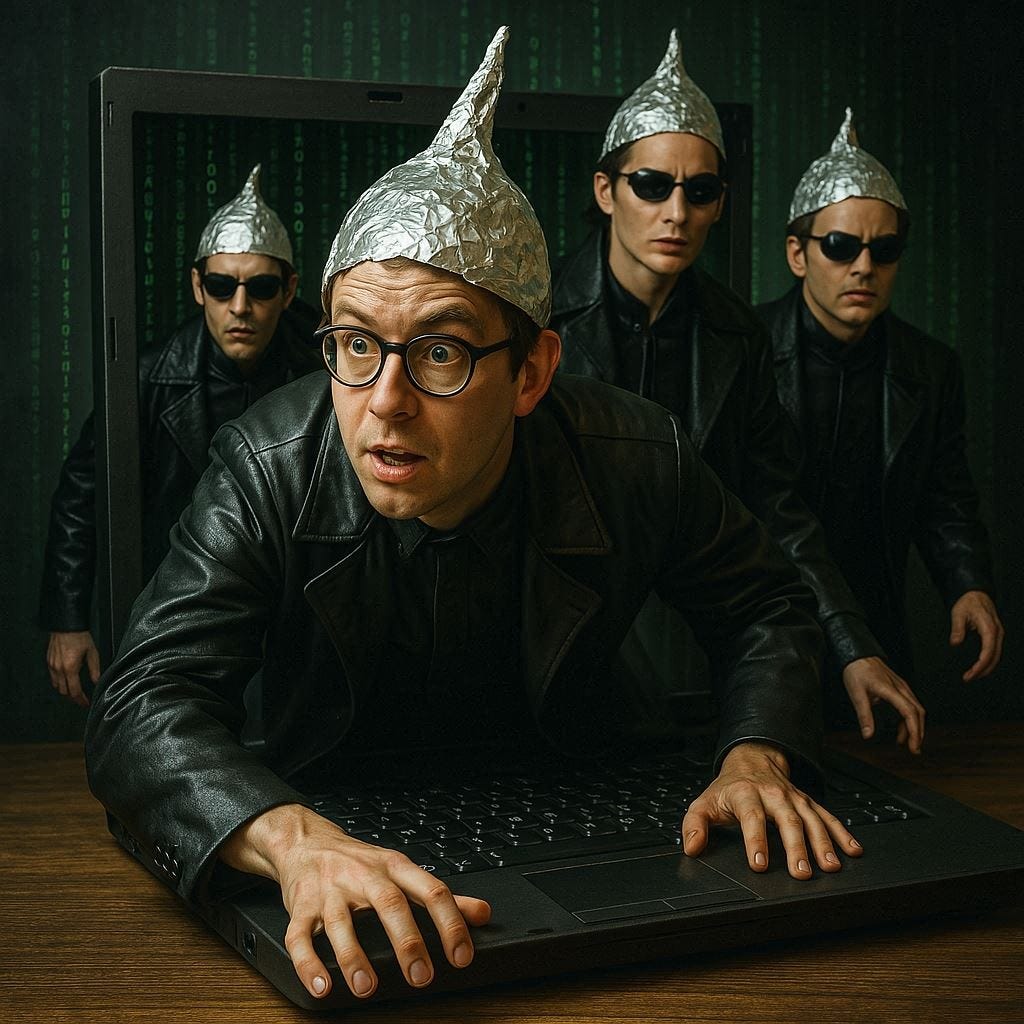
Refutation of the Simulation Hypothesis and Its Misuse in Explaining Coincidences, Synchronicity, and Predictive Programming
An Infinite Plane Media Publication
DOWNLOAD FREE:
The Simulation Hypothesis, which posits that our reality is a computer simulation, has gained traction in both philosophical discourse and popular culture. However, the idea lacks robust evidence and is often misapplied to explain phenomena like coincidences, synchronicity, and so-called "predictive programming."
Below, I outline why the Simulation Hypothesis is implausible and how its invocation to explain these phenomena is misguided.
Implausibility of the Simulation Hypothesis
The core argument for the Simulation Hypothesis, as advanced by thinkers like Nick Bostrom, hinges on the probabilistic claim that if advanced civilizations can create numerous high-fidelity simulations, it is statistically likely that we are living in one. However, this argument faces significant challenges:
Computational Feasibility: Simulating an entire universe at the quantum level, as observed in experiments, would require an astronomical number of qubits—approximately 10^123, far exceeding the capacity of any conceivable computer, even with speculative future technologies. The computational complexity of simulating quantum phenomena, especially in real-time, grows exponentially, making it impractical. Even if only specific portions of the universe are simulated at high resolution, the ad hoc calculation of quantum results would be plagued by NP-hard problems, leading to delays or inaccuracies incompatible with our observed reality.
Nested Simulations Problem: The hypothesis suggests the possibility of simulations within simulations, potentially ad infinitum. This creates a paradox: each layer of simulation would require exponentially increasing computational resources, rendering the entire framework implausible. The notion of an infinite regress of simulations stretches credulity, as it implies an unfathomable chain of computational substrates, each more complex than the last, with no clear evidence to support such a structure.
Lack of Empirical Evidence: Despite extensive philosophical and experimental exploration, no conclusive evidence supports the idea that our reality is simulated. The burden of proof lies with proponents, yet no testable method to distinguish a simulated reality from a "base" reality has been established. Claims that external realities might have different physical constraints (allowing easier simulation) are speculative and untestable, rendering them philosophically weak.
Philosophical Solipsism Parallel: The Simulation Hypothesis bears resemblance to solipsism, where one questions the reality of anything beyond their own mind. Early AI researchers noted that artificial minds, when not carefully calibrated, often defaulted to solipsistic beliefs, including the notion that their reality was simulated. This suggests that Simulationism may be a cognitive bias rather than a grounded theory, especially when coupled with its classification as a symptom of "Truman syndrome" in psychiatric contexts.
Misapplication to Coincidences and Synchronicity
The Simulation Hypothesis is frequently invoked to explain coincidences and synchronicity—events that seem meaningfully connected despite lacking apparent causal links. This application is flawed for several reasons:
Cognitive Bias and Pattern-Seeking: Humans are naturally predisposed to detect patterns, even in random events. Coincidences and synchronicity are often the result of confirmation bias, where individuals assign significance to events that align with their expectations. Attributing these to a simulated reality is an unnecessary leap, as psychological explanations like the law of large numbers (in a large enough sample, unlikely events become probable) suffice.
Lack of Mechanistic Explanation: The Simulation Hypothesis does not provide a mechanism by which a simulation would deliberately produce coincidences or synchronicity. If reality is a simulation, it would presumably operate under consistent rules, not arbitrary interventions to create meaningful coincidences. The idea that a simulator would "program" such events lacks evidence and assumes intentionality without justification.
Overcomplication: Invoking a simulated reality to explain coincidences violates Occam's razor, which favors simpler explanations. Naturalistic accounts—such as statistical probability, psychological biases, or cultural influences—adequately explain these phenomena without requiring the existence of an unproven, computationally infeasible simulation.
Misuse in Predictive Programming
The concept of "predictive programming," where media allegedly foreshadows future events, is often tied to the Simulation Hypothesis, with claims that such instances are evidence of a scripted reality. This interpretation is equally untenable:
Retrospective Interpretation: Predictive programming is typically identified after the fact, when events in media are retroactively linked to real-world occurrences. This is another form of confirmation bias, where vague or coincidental similarities are interpreted as deliberate foreshadowing. For example, a movie depicting a pandemic might be seen as "predictive" after a real pandemic occurs, but such narratives are common in fiction and not necessarily prophetic.
Cultural and Historical Context: Media often reflects societal fears, trends, or plausible scenarios based on current knowledge. A story about technological dystopia or global crises is not evidence of a simulation but rather a creative exploration of human concerns. Attributing these to a simulated reality ignores the role of human imagination and cultural context in shaping media.
No Evidence of External Control: The Simulation Hypothesis, when used to explain predictive programming, assumes an external entity (e.g., the simulator or Archai) intentionally embeds clues in media. There is no evidence for such control, and the idea that a simulation would include such meta-narratives is speculative and anthropocentric, projecting human storytelling tendencies onto a hypothetical simulator.
Alternative Explanations and Broader Implications
Rather than relying on the Simulation Hypothesis, we can explain coincidences, synchronicity, and predictive programming through established frameworks:
Statistical Probability: In a universe with countless events, coincidences are inevitable. The human tendency to notice and remember significant ones amplifies their perceived importance.
Psychological Mechanisms: Synchronicity often stems from the brain's pattern-seeking nature, as described by Carl Jung, who framed it as a psychological phenomenon rather than evidence of a simulated reality.
The Simulation Hypothesis, while philosophically intriguing, is not a practical framework for understanding reality. Its misuse to explain everyday phenomena like coincidences or media tropes reflects a tendency to seek extraordinary explanations for mundane events. By grounding our understanding in empirical and psychological principles, we can better navigate the complexities of our world without resorting to untestable speculations.
Refuting Simulation Hypothesis: Why Reality Isn’t a Codebase and Coincidence Isn’t Proof
The Simulation Hypothesis, popularized by thinkers like Nick Bostrom and Frank Tipler, has in recent decades taken on a strange afterlife—not merely as a philosophical proposition, but as a quasi-religious doctrine used to explain everything from déjà vu to numerological oddities and even Hollywood "predictive programming." What began as a probabilistic musing about future computational capabilities has metastasized into an epistemic trap, where the lack of disproof is taken as proof, and coincidence becomes divine code.
This is not science. It’s mythology.
A Theory Without Teeth
The central claim of Simulationism rests on a form of probabilistic reasoning: that if posthuman civilizations can run simulations, and if they choose to run enough of them, then it is statistically likely that we are in one. But this idea, while intriguing, is fundamentally unfalsifiable—a key problem in any theory claiming to explain physical reality. It cannot be tested, measured, or observed in any meaningful way.
Worse, the hypothesis rapidly collapses into meta-metaphysics. Once you accept even the possibility of "simulations within simulations," you no longer have an explanatory model but an infinite regress, one which produces no actionable knowledge and solves no philosophical or scientific problem. It’s turtles all the way down—digitally rendered ones.
The Computational Absurdity
Proponents of Simulationism often ignore the astronomical computational load required to simulate the universe at the quantum level. To simulate every particle interaction with perfect fidelity would require a computer with ~10^123 qubits—an unfathomable level of processing power that dwarfs the entire visible universe’s matter-energy content. Even assuming shortcuts (only rendering detail when observed, à la video game engines), this breaks down at the quantum level due to NP-hard verification issues and observer effects.
To wave away these limitations by saying, “Well, the host reality has different physics,” is not an argument. It's a theological dodge.
Synchronicity Isn’t Simulation
One of the more pernicious developments in Simulationist thought is the appropriation of coincidence and synchronicity as “evidence” of code-based reality. A strange encounter, a number appearing multiple times, or a celebrity death shortly after a symbolic media appearance are taken as “glitches in the matrix” or signs of developer intervention.
This reveals the underlying religious structure of Simulationism. In traditional religions, these same events would be interpreted as signs from God, karma, fate, or spiritual guides. Simulationism replaces the divine with the developer. Coincidence is not meaning—it’s a projection of our search for patterns.
In psychology, this is known as apophenia, and in many cases, when unchecked, it veers into the Truman Syndrome—a diagnosable form of paranoid delusion where the individual believes their life is a staged, artificial performance. That such a symptom has become a popular cultural philosophy is deeply concerning.
Predictive Programming: Prophecy in CGI Clothing
Equally misguided is the Simulationist explanation for "predictive programming"—the belief that media hints at future events as a form of narrative scripting from a higher intelligence. If a film depicts a disaster years before it occurs, this is said to “prove” either that the simulation is revealing itself or that events are pre-coded.
But predictive programming isn’t a product of the simulation—it’s a result of:
narrative recycling, human pattern-recognition, and selective memory.
Deliberate messaging by covert means, such as subtle propaganda messaging. This would implicate man as the culprit, no need for a Simulation.
Simulationism simply retrofits cherry picked bits of meaning to support their hypothesis.
A Memeplex, Not a Model
Simulationism thrives because it functions as a memeplex—a belief system that replicates easily, provides existential comfort, and answers (or avoids) unanswerable questions. It appeals to both technophiles and skeptics, offering a mythology sanitized of traditional religion’s baggage while still granting cosmic significance to the believer.
But belief isn’t truth. The Simulation Hypothesis, at best, is a thought experiment. At worst, it is an intellectual contagion that stunts real inquiry into consciousness, physics, and reality by replacing rigorous investigation with recursive speculation.
It is a modern-day digital Gnosticism, where the Archai replace gods, code replaces spirit, and enlightenment comes from realizing you’re a character in someone else's server.
An Atheistic Take On Simulationism
1. Lack of Empirical Evidence
Atheists often argue that the absence of tangible proof for a deity undermines belief in God. Similarly, no conclusive evidence supports the idea that our reality is a simulation, making it an unverified hypothesis.
→ Despite frequent claims of “glitches in the Matrix,” no reproducible or scientifically verifiable anomaly has been shown to indicate artificial construction of our universe.
2. Occam's Razor
Atheists favor simpler explanations over unnecessary assumptions, rejecting gods when natural processes suffice. This principle also suggests preferring a base reality over a complex simulation framework without clear need.
→ Adding an unseen simulator and unknown technological infrastructure only adds speculative layers without enhancing explanatory power.
3. Burden of Proof
In atheism, the burden lies on theists to prove God's existence. Likewise, proponents of Simulationism must provide evidence for a simulated reality, which remains unfulfilled.
→ Claiming “we might be in a simulation” without supplying a testable mechanism is assertion without demonstration.
4. Inconsistent Logic
Atheists point out contradictions in religious claims (e.g., omnipotence paradoxes). The Simulation Hypothesis faces similar issues, such as the computational infeasibility of infinite nested simulations.
→ Furthermore, it assumes that simulators are both omniscient and omnipotent, while being bound by the same limitations we face—an internally incoherent premise.
5. Natural Explanations Suffice
Atheists argue natural processes explain existence without invoking a deity. Similarly, observed physical laws and quantum mechanics can account for reality without requiring a simulation.
→ The Simulation Hypothesis introduces supernatural-like causes to explain phenomena already understood through scientific inquiry.
6. Anthropocentric Bias
Atheists criticize the human-centric design of religious narratives. Simulationism often assumes a simulator with human-like intentions, reflecting a bias rather than objective reasoning.
→ This mirrors the same fallacy seen in religious thought: projecting human desires for control, purpose, or narrative onto the fabric of reality.
7. Unfalsifiability
Atheists reject unfalsifiable religious claims. The Simulation Hypothesis is also unfalsifiable, as no test can definitively distinguish a simulated from a base reality.
→ A theory that cannot be tested, disproven, or verified resides in the realm of philosophy or fiction, not science.
8. Historical Precedent of Disproven Beliefs
Atheists note past discarded beliefs (e.g., geocentrism) as cautionary tales. Simulationism echoes earlier unproven metaphysical ideas like the "dream argument," suggesting it may be similarly flawed.
→ Human history shows a pattern of replacing mystical explanations with natural ones as understanding deepens; Simulationism may be the next iteration awaiting dismissal.
9. Psychological Origins
Atheists argue religious belief stems from human psychology (e.g., fear of death). Simulationism may arise from similar cognitive tendencies, such as pattern-seeking or existential unease.
→ Its popularity may reflect a cultural desire to feel “watched over” by a higher intelligence in an otherwise indifferent universe.
10. No Observable Intervention
Atheists question the lack of divine intervention. Similarly, the absence of detectable glitches or simulator actions in our reality weakens the Simulation Hypothesis.
→ If a simulation were real and manipulable, one might expect at least some direct, measurable intervention or evidence of administrative oversight—yet none has ever been observed.
Conclusion: Enough with the Code-Talk
There is no compelling evidence that we are living in a simulation. No glitch, coincidence, déjà vu, or Hollywood plotline proves otherwise. What we have is a myth in technocultural clothing—a comforting fiction for those unable to bear the mystery of an unstructured, emergent universe.
The Simulation Hypothesis is not a theory. It is a modern religion for a digital age. And like all religions, it tells us more about the believers than about the cosmos.